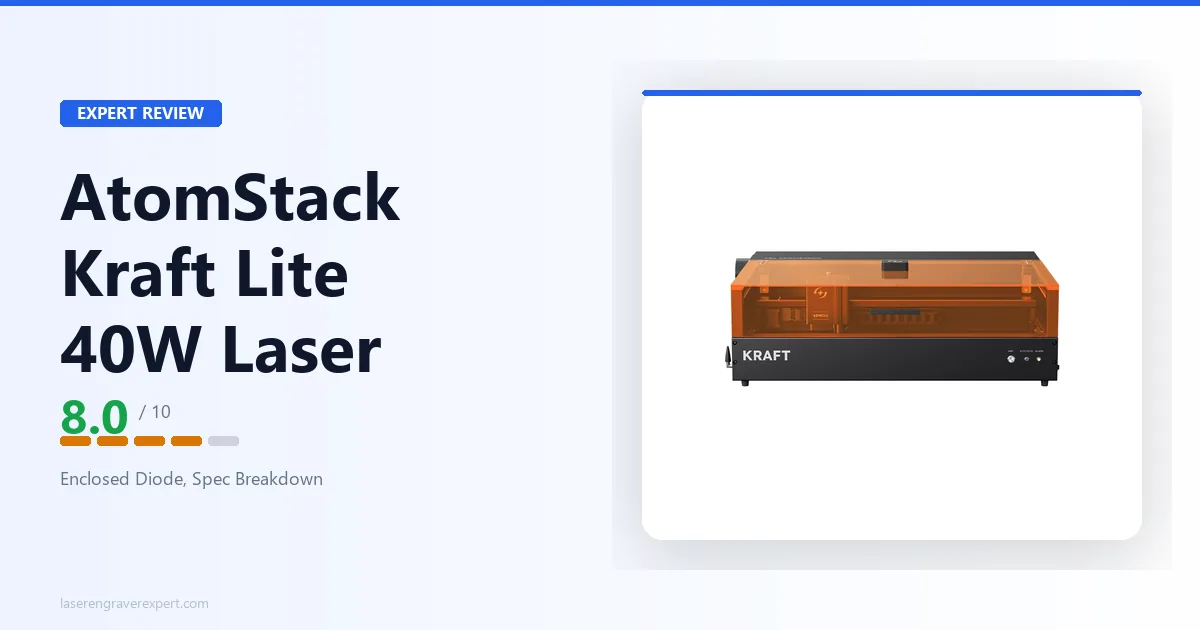
This AtomStack Kraft Lite 40W review looks at where the enclosed, single-diode member of AtomStack’s Kraft line fits: a 40W diode laser rated to cut 18mm Paulownia in a single pass, a 19.6 × 12.6in bed that extends with a conveyor feeder, and a built-in 16MP camera, all inside a Class-1 enclosed body aimed at makers, studios, and small businesses. This review covers what that enclosed format and 40W of diode power actually get you, how it compares to AtomStack’s open-frame A24 Pro , and who should buy it.
This article contains affiliate links. If you purchase through our links, we may earn a commission at no extra cost to you.
Check Current Price on Amazon →
AtomStack Kraft Lite 40W Specs at a Glance
| Specification | Value |
|---|---|
| Laser Type | Diode (single source) |
| Optical Output Power | 40W |
| Work Area | 19.6 × 12.6in |
| Work Area (with conveyor feeder) | 19.6 × 31.5in |
| Max Cutting (rated) | 18mm Paulownia wood, single pass |
| Enclosure | Yes (enclosed body) |
| Safety Class | Class 1 (IEC certified) |
| Camera | Built-in 16MP 4K HD |
| Laser Wavelength | Not listed |
| Spot Size | Not listed |
| Max Engraving Speed | Not listed |
| Autofocus | Not listed |
| Connectivity | Not listed |
| Compatible Software | Not listed (LightBurn not confirmed) |
| Machine Dimensions | Not listed |
| Weight | Not listed |
| Accessory Ecosystem | Fire-extinguishing air pump, rotary roller & chuck, riser base, air purifier |
| Configurations | Basic, Rotary, Expansion, Ultimate bundles (US & EU plug) |
| Warranty | 12-month |
| Availability | Out of stock (all configurations at time of writing) |
Check Current Price on Amazon →
A word on what’s in that table. AtomStack does not publish a full structured spec sheet for the Kraft Lite, so this review is built on the specifications AtomStack does state plainly: a 40W diode, an enclosed Class-1 body, the 19.6 × 12.6in bed and its conveyor extension, the 18mm Paulownia cut rating, and the built-in 16MP camera. Where a figure isn’t published, this review marks it Not listed rather than guessing. Wavelength, spot size, top engraving speed, connectivity, and the exact software path all fall into that category. If a specific one of those is decision-critical for you, confirm it against AtomStack’s current listing for this exact model before buying.
What the AtomStack Kraft Lite Is For
The Kraft Lite’s name tells you most of what you need to know about its positioning. It’s the “Lite” member of AtomStack’s Kraft line: enclosed like the rest of the Kraft family, but built around a single 40W diode rather than a dual-source head. The AtomStack Kraft Dual-laser is the step-up dual-source sibling, pairing a diode with an IR module for metal marking; the Kraft Lite strips that back to one high-power diode and focuses on being an enclosed, approachable machine for makers, studios, and small businesses.
That positioning matters because it places the Kraft Lite in a specific gap in the market. Most of AtomStack’s cutting-power machines, including the A24 Pro , are open-frame: cheaper, but you supply your own fume extraction and the beam path isn’t contained. Fully enclosed machines are safer and cleaner to run indoors but usually cost more. The Kraft Lite lands in the middle: an enclosed, Class-1-certified body with genuine diode cutting power behind it.
What that enclosed format gets you in practice:
- Class-1 safety. The enclosed body earns an IEC Class-1 Laser Safety Certification, which is the rating you want for running a laser in a shared or indoor space without relying on goggles for every moment of operation.
- Cleaner operation. An enclosed body contains debris and makes fume routing more practical, especially paired with the air purifier in the Kraft Lite accessory ecosystem.
- A camera-assisted workflow. The built-in 16MP 4K camera lets you see the bed and place designs visually rather than working blind from coordinates, which is one of the bigger quality-of-life gaps on open-frame machines.
Pair all of that with a 40W diode rated to cut 18mm Paulownia in a single pass, and the picture is clear: this is an enclosed diode built for people who want to cut real wood thickness and engrave safely indoors, without stepping up to a dual-source or CO2 machine.
AtomStack Kraft Lite in the AtomStack Lineup
The most useful way to understand the Kraft Lite is by where it sits relative to its siblings.
| AtomStack A24 Pro | AtomStack Kraft Lite 40W | |
|---|---|---|
| Laser power | 20–24W optical | 40W optical (single diode) |
| Laser sources | Single diode | Single diode |
| Work area | 365 × 305mm | 19.6 × 12.6in (~498 × 320mm) |
| Work area extension | None | Conveyor feeder to 19.6 × 31.5in |
| Enclosure | Open frame | Enclosed |
| Safety class | Not listed | Class 1 (IEC) |
| Camera | None | Built-in 16MP 4K |
| Rated cutting | 12–15mm wood (single pass) | 18mm Paulownia (single pass) |
| Best for | Budget open-frame cutting | Enclosed, safe indoor cutting |
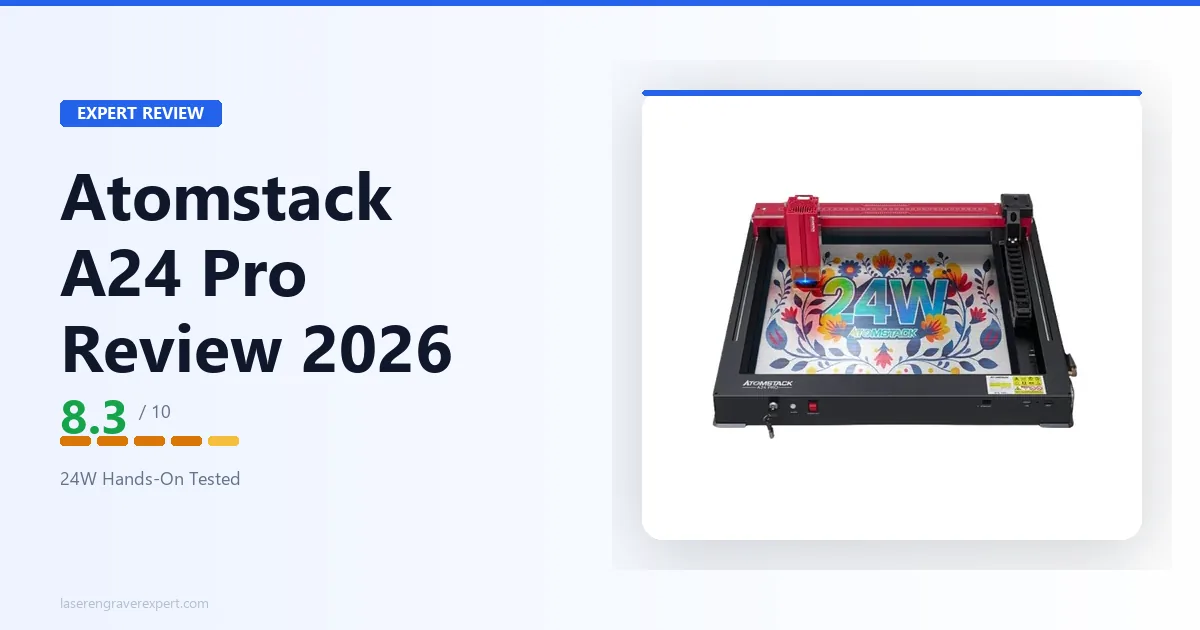
The A24 Pro is the machine many AtomStack buyers start with: a capable open-frame diode engraver at a budget price. The Kraft Lite is a different proposition. It’s not a straight power bump so much as a format change: you’re paying for the enclosure, the Class-1 certification, the built-in camera, and more diode power, in exchange for a higher price and a larger footprint.
Within the Kraft line itself, the Kraft Lite is the single-diode entry and the Kraft Dual-laser is the dual-source step-up. The Dual-laser trades some diode power for an added IR module that can mark bare metals a diode can’t touch. If your work is wood, acrylic, and leather, the Kraft Lite’s extra diode cutting power is the more relevant feature; if direct metal marking is on your list, the Dual-laser is the sibling to look at. (The Kraft Dual-laser isn’t reviewed on the site yet, so this is a name-check so you know the step-up exists in the same family.)
For buyers who need a much larger bed, AtomStack’s open-frame A70 Max offers a far bigger work area with switchable 70W/35W power, though it gives up the enclosed format entirely. The Kraft Lite’s pitch is specifically the combination of enclosure plus solid diode power, not maximum bed size.
AtomStack Kraft Lite Materials and Cutting Capability
As a diode laser, the Kraft Lite follows the same material rules as the rest of the diode category, with the advantage of 40W of optical power behind them.
Where the 40W earns its place is cutting. The rated figure, cutting through 18mm Paulownia in a single pass, is a strong number for a diode and points to meaningful headroom on softer and medium-density woods. Wood, plywood, MDF, leather, card, and dark or opaque acrylics are all well within the diode-friendly range, and the extra power means thicker stock in fewer passes than a 20W machine would manage on the same material. Paulownia is a light, low-density hardwood, so an 18mm single-pass cut on denser species like birch or oak will be thinner in practice, but it still signals a machine with real cutting capability rather than an engraving-first design.
The hard limits are the same as every diode laser. Clear acrylic does not cut cleanly on any diode: the blue-diode wavelength passes through clear material rather than being absorbed, regardless of wattage. And a diode cannot mark bare metal the way a fiber or IR laser can. This is where the single-source Kraft Lite differs from the dual-source Kraft Dual-laser: the Dual-laser’s IR module adds bare-metal marking, while the Lite stays within diode material limits. If clear acrylic or glass cutting is central to your work, a CO2 machine is the right direction; our best CO2 laser engraver guide covers those options.
One honest caveat on materials: AtomStack doesn’t publish a detailed material compatibility list or specific recommended settings for the Kraft Lite in the available information. The categories above follow from it being a 40W blue diode, which is well-understood, but for any unusual material, confirm suitability before committing a project to it.
AtomStack Kraft Lite Workflow: Camera, Enclosure, and Conveyor
For an enclosed machine aimed at studios and small businesses, workflow features matter as much as raw power, and the Kraft Lite leans into three in particular.
The built-in 16MP 4K camera is the standout. On a machine without one, you position designs from a coordinate system and framing passes, which is workable but slow and error-prone for one-off or irregular workpieces. A high-resolution overhead camera lets you see the bed, place the design visually on top of the actual material, and reduce wasted stock from mis-registration. For batch work and custom one-offs, that’s a genuine time-saver, and a 16MP sensor is a step above the lower-resolution cameras on some competing machines.
The enclosed body is the format advantage. Beyond the Class-1 safety rating, an enclosure contains debris, cuts down on stray light, and makes the machine more pleasant and more practical to run in a shared workspace. It pairs naturally with the air purifier in the accessory ecosystem for a more self-contained setup, though as with any laser you should still plan proper fume handling rather than assuming an enclosure makes exhaust optional.
The conveyor feeder extends the standard 19.6 × 12.6in bed to 19.6 × 31.5in and, because it advances material through the machine, opens up longer or repeating work than the fixed bed alone would allow. For long signage, continuous patterns, or feeding a run of smaller pieces through in sequence, that’s a useful capability to have available, even if it’s an accessory rather than a standard inclusion.
What the published information doesn’t detail is the connectivity and software path. AtomStack’s machines are generally LightBurn-friendly, and most buyers at this level will want to run LightBurn, but the Kraft Lite’s specific controller and confirmed software list aren’t published in the available data. If LightBurn is a hard requirement, confirm it for this exact model before purchase rather than assuming it carries over from other AtomStack machines.
AtomStack Kraft Lite Pros and Cons
Pros:
- Enclosed body with Class-1 (IEC) laser safety certification: safer and cleaner for indoor and shared-space use than open-frame alternatives.
- 40W diode rated to cut 18mm Paulownia in a single pass: genuine cutting headroom for a diode.
- Built-in 16MP 4K camera for visual job placement, a real workflow advantage over camera-less machines.
- Conveyor feeder extends the bed to 19.6 × 31.5in for long or continuous material.
- Accessory ecosystem (fire-extinguishing air pump, rotary, riser base, air purifier) supports a more complete, self-contained setup.
Cons:
- Single 40W diode only: no IR module, so no bare-metal marking (the Kraft Dual-laser is the sibling for that), and clear acrylic won’t cut (diode-laser limitation).
- AtomStack publishes very little structured spec detail: wavelength, spot size, top speed, connectivity, and software are all unconfirmed.
- Out of stock across all configurations at the time of writing, so availability is a real planning concern.
- An enclosed machine with this bed size is a larger footprint and a higher investment than an open-frame engraver.
The enclosed format, 40W diode power, and built-in camera are the real strengths; the single-source material limits, thin published spec detail, and stock situation are the trade-offs to weigh.
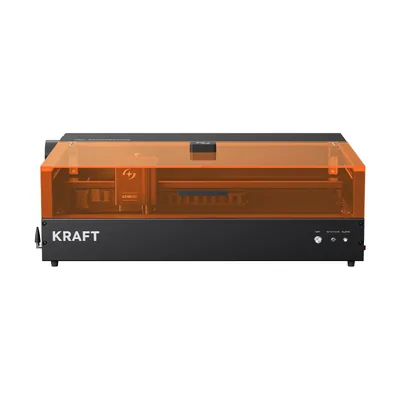
AtomStack Kraft Lite 40W
8.1/10- Enclosed body with Class-1 (IEC) laser safety certification
- 40W diode rated to cut 18mm Paulownia in a single pass
- Built-in 16MP 4K camera for visual job placement
- Conveyor feeder extends the bed to 19.6 × 31.5in
- Accessory ecosystem including rotary, riser base, and air purifier
- Single diode only: no bare-metal marking (see the Kraft Dual-laser for that)
- Clear acrylic won't cut (diode-laser limitation)
- Very little published spec detail: speed, wavelength, software unconfirmed
- Out of stock across all configurations at the time of writing
AtomStack Kraft Lite vs AtomStack A24 Pro
The most natural in-brand comparison is against the open-frame AtomStack A24 Pro , because it highlights the enclosed-vs-open-frame trade-off at the heart of the Kraft Lite’s pitch.
These machines solve the same problem, cutting and engraving wood, acrylic, and leather, in two different ways. The A24 Pro is an open-frame diode engraver: up to 24W of optical power, a 365 × 305mm bed, and a budget-friendly price. Its format is its main limitation: no enclosure means fume extraction, stray light, and the beam path are all your responsibility, so it really wants a garage or workshop with proper ventilation.
The Kraft Lite is an enclosed machine with a larger 19.6 × 12.6in bed, more diode power at 40W, a Class-1 safety rating, and a built-in camera the A24 Pro doesn’t have. In other words, you’re paying more to get the format and workflow features, not just more watts.
The decision framework is straightforward. If you have a ventilated workshop, want maximum cutting value per dollar, and are comfortable managing an open-frame setup yourself, the A24 Pro is the smarter buy. If you want to run a laser safely indoors or in a shared space, value the enclosed format and the camera-assisted workflow, and want the extra diode power for heavier wood cutting, the Kraft Lite is built for exactly that. One real caveat tilts toward the A24 Pro for spec-sensitive buyers: AtomStack publishes a far more complete spec sheet for the A24 Pro (wavelength, spot size, speed, certifications all stated) than it does for the Kraft Lite, so if you need every number confirmed up front, the A24 Pro is the better-documented machine.
AtomStack Kraft Lite vs Kraft Dual-laser
Worth naming clearly, because it’s the most direct in-family decision: the Kraft Lite is the single-source model, and the Kraft Dual-laser is the dual-source step-up in the same enclosed line.
The core difference is laser sources. The Kraft Lite is a single 40W diode: more raw diode cutting power, better suited to heavier wood cutting. The Kraft Dual-laser pairs a 20W diode with a 1.2W IR laser, which adds the ability to mark bare metals, stainless steel, brass, anodized aluminum, that no diode can touch, at the cost of less diode cutting power.
They’re complementary rather than strictly better-or-worse. If your work is wood, acrylic, and leather and you want the most cutting headroom, the Kraft Lite’s 40W diode is the stronger choice. If direct metal marking is part of your business, jewelry tags, branded hardware, serial numbers on metal, the Dual-laser’s IR module is the feature that matters, and the Lite simply can’t do it. The Kraft Dual-laser’s own detailed review isn’t published yet; this is a name-check so you know the dual-source sibling exists in the same family.
Who Should Buy the AtomStack Kraft Lite?
The maker or studio who wants enclosed safety. If you’re running a laser in a home studio, a classroom, a shared makerspace, or anywhere that an open-frame machine’s uncontained beam and fumes would be a problem, the Kraft Lite’s enclosed Class-1 body is the core reason to choose it. It’s a machine you can run around other people more comfortably.
The small business cutting wood and acrylic. The 40W diode and 18mm Paulownia single-pass rating give it real production cutting capability for signage, ornaments, wood blanks, and dark-acrylic work, and the conveyor feeder opens up long or continuous material. If you’re building a laser-based business, our best laser engraver for small business guide covers how an enclosed diode like this fits alongside open-frame and CO2 options.
The buyer who values a camera-assisted workflow. The built-in 16MP 4K camera is a genuine productivity feature for anyone doing one-offs, custom placement on irregular stock, or batch layouts. If you’ve been working blind from coordinates on a camera-less machine, this is a noticeable upgrade.
Who Should Skip the AtomStack Kraft Lite?
Anyone who needs to mark bare metal. The Kraft Lite is a single diode, and diodes can’t mark bare metal. If metal marking is central to your work, look at the dual-source Kraft Dual-laser (diode + IR) or a dedicated fiber machine instead.
Buyers who need clear acrylic or glass. As a diode laser, the Kraft Lite can’t cut clear acrylic, and glass work is outside its range. If that’s central to your projects, a CO2 machine is the correct tool; see our best CO2 laser engraver guide .
Budget-focused buyers with a ventilated workshop. If you already have proper ventilation and just want maximum cutting value, an open-frame machine like the A24 Pro delivers more watts per dollar. You’re paying a premium for the Kraft Lite’s enclosure and camera, which only pays off if you actually need them.
Buyers who need every spec confirmed up front. AtomStack publishes very little structured spec detail for the Kraft Lite. If you require published wavelength, spot size, top speed, and certified software compatibility before committing, either confirm those directly with AtomStack for this exact model first, or choose a better-documented machine.
Anyone who needs it immediately. It was out of stock across all configurations at the time of writing. If you need a machine now, check current availability before planning around it.
AtomStack Kraft Lite Review: Final Verdict
The AtomStack Kraft Lite 40W is a focused machine with a clear pitch: an enclosed, Class-1 diode laser with real cutting power and a camera-assisted workflow, aimed at makers, studios, and small businesses who want to work safely indoors without stepping up to a dual-source or CO2 machine.
Here’s how to think about it. If you want the enclosed format and the safety and cleanliness that come with it, if 40W of diode power rated to cut 18mm Paulownia in a single pass covers your material list, and if a built-in 16MP camera would improve your workflow, the Kraft Lite is built for exactly that combination. The enclosure, the camera, and the conveyor-extendable bed are the features that justify choosing it over a cheaper open-frame machine.
Where it asks something of you: it’s a single diode, so no bare-metal marking and no clear acrylic, and AtomStack publishes so little structured spec detail that spec-sensitive buyers will need to confirm key numbers directly before buying. And it was out of stock across all configurations at the time of writing, so availability is a real consideration rather than a footnote.
Rating: 8.1/10. A solid enclosed diode for makers and small businesses who value the format and the camera-assisted workflow, held back from a higher score mainly by the thin published spec detail and the stock situation rather than by the hardware itself.
Ready to buy?
See the AtomStack Kraft Lite on Amazon →Still mapping out the right machine for a growing workflow? Our best laser engraver for small business roundup and best CO2 laser engraver guide cover the full field of enclosed, open-frame, and CO2 options, and our AtomStack A24 Pro review covers the open-frame alternative in the same brand.