See Current Sculpfun E1 Pro Price →
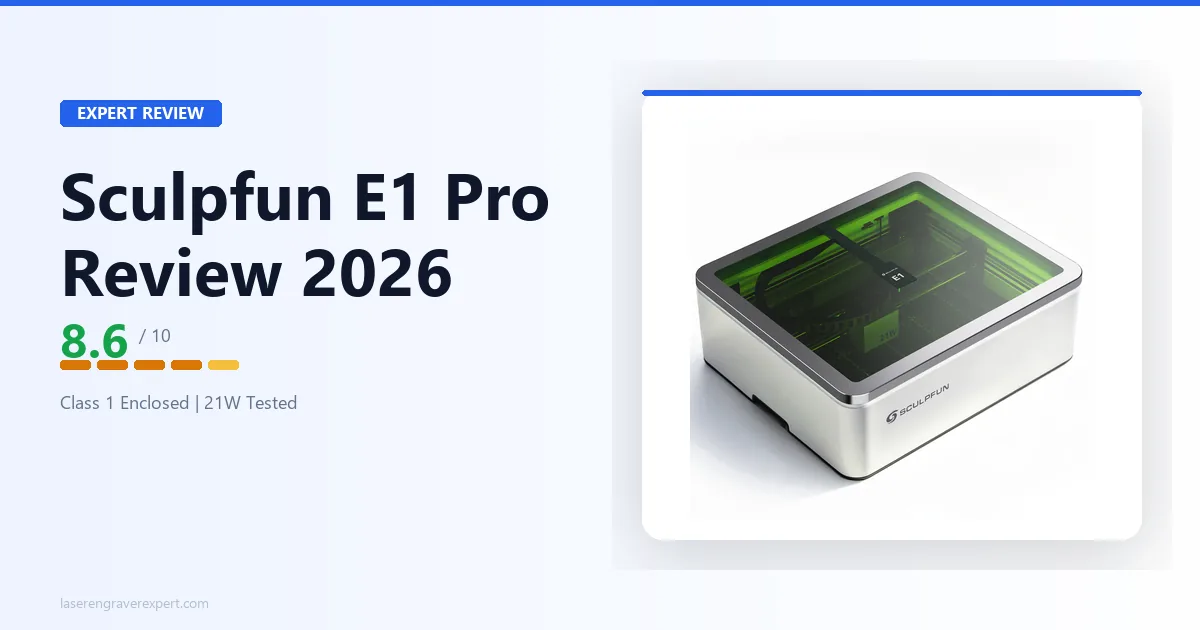
The Sculpfun E1 Pro is a 21W enclosed diode laser with CoreXY motion, a built-in HD camera, and Class 1 safety, all under $550. That package was solidly mid-range pricing two years ago.
This Sculpfun E1 Pro review covers what 21W actually unlocks over the base E1, when the upgrade is worth it, and exactly where the diode ceiling kicks in.
Sculpfun E1 Pro Specifications
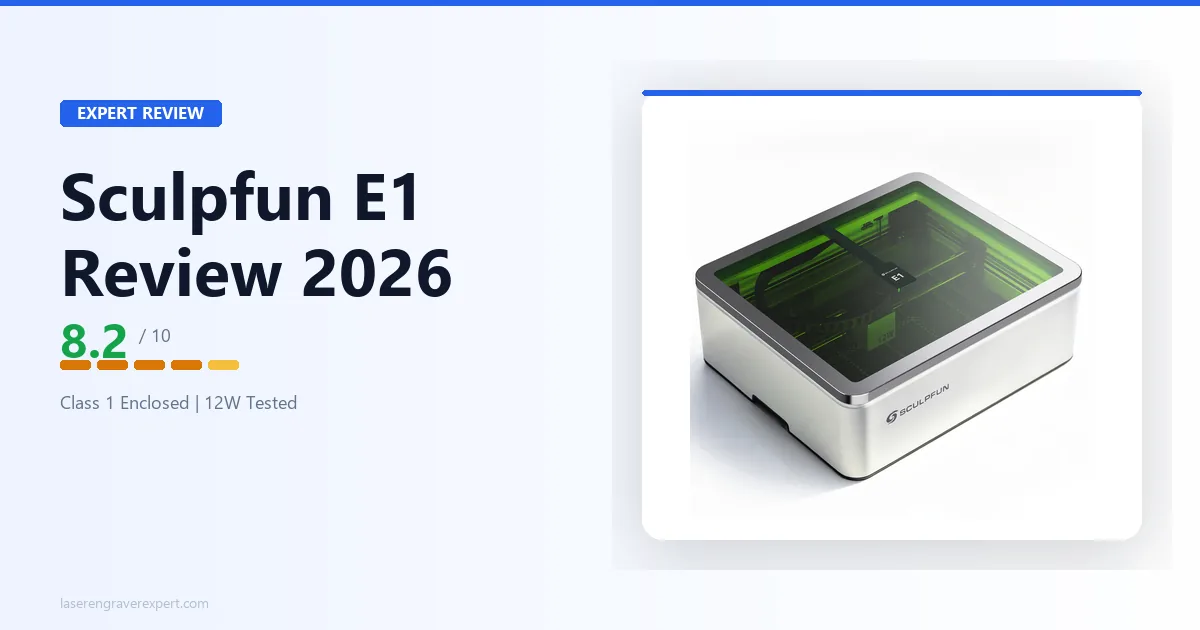
The Sculpfun E1 Pro is a 21W enclosed diode laser engraver with a 400 × 320mm work area, CoreXY motion system, and a built-in HD camera for job positioning. CE, FCC, RoHS, and IEC60825 certified.
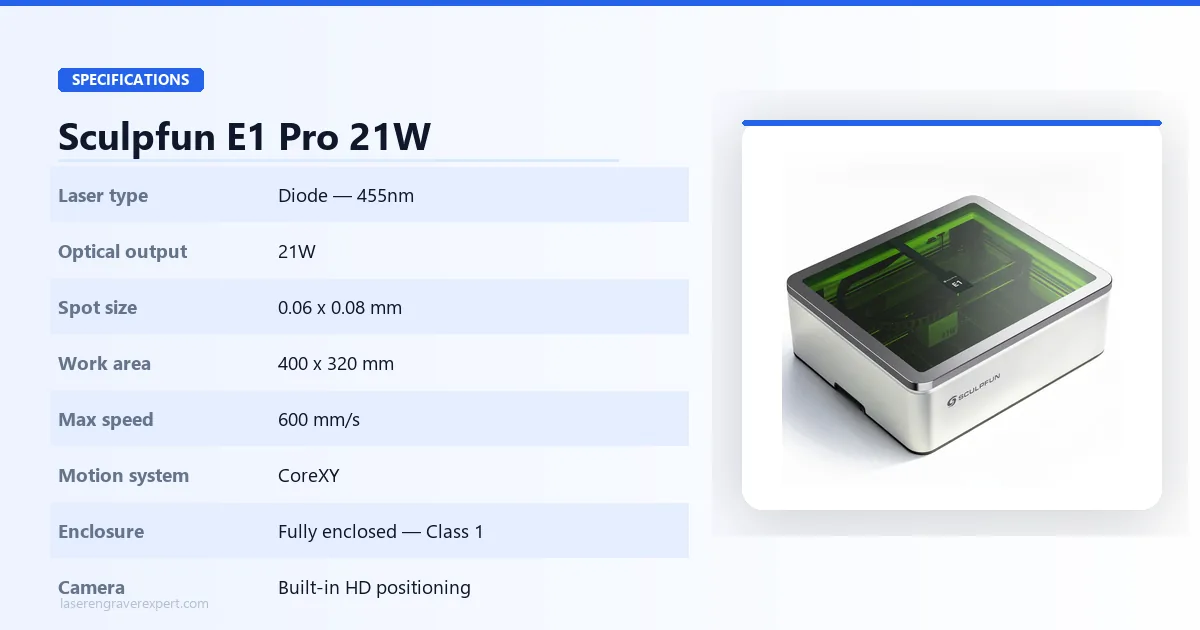
| Specification | Detail |
|---|---|
| Laser Type | Diode, 455nm |
| Optical Power | 21W |
| Spot Size | 0.06 × 0.08mm |
| Work Area | 400 × 320mm |
| Max Engraving Speed | 600mm/s |
| Motion System | CoreXY |
| Enclosure | Fully enclosed, Class 1 |
| Camera | Built-in HD positioning camera |
| Connectivity | USB, Wi-Fi |
| Compatible Software | Sculpfun Space, LightBurn, LaserGRBL |
| Supported File Types | JPEG, PNG, JPG, BMP, SVG, DXF |
| Operating System | Windows, macOS, Android, iOS |
| Safety Features | Lid-open auto pause, emergency stop, protective viewing cover |
| Air System | Built-in exhaust airflow |
| Input Voltage | 24V 6A |
| Machine Dimensions | 590 × 500 × 205mm |
| Machine Weight | 11.95kg |
| Certifications | CE, FCC, RoHS, IEC60825 |
| Engravable Materials | Wood, MDF, Bamboo, Leather, Dark/Opaque Acrylic, Stone, Ceramic, Glass, Coated Metal |
| Cuttable Materials | Wood, MDF, Plywood, Leather, Dark Acrylic |
| Estimated Price | ~$449–$549 |
Sculpfun E1 Pro Design, Safety, and Build Quality
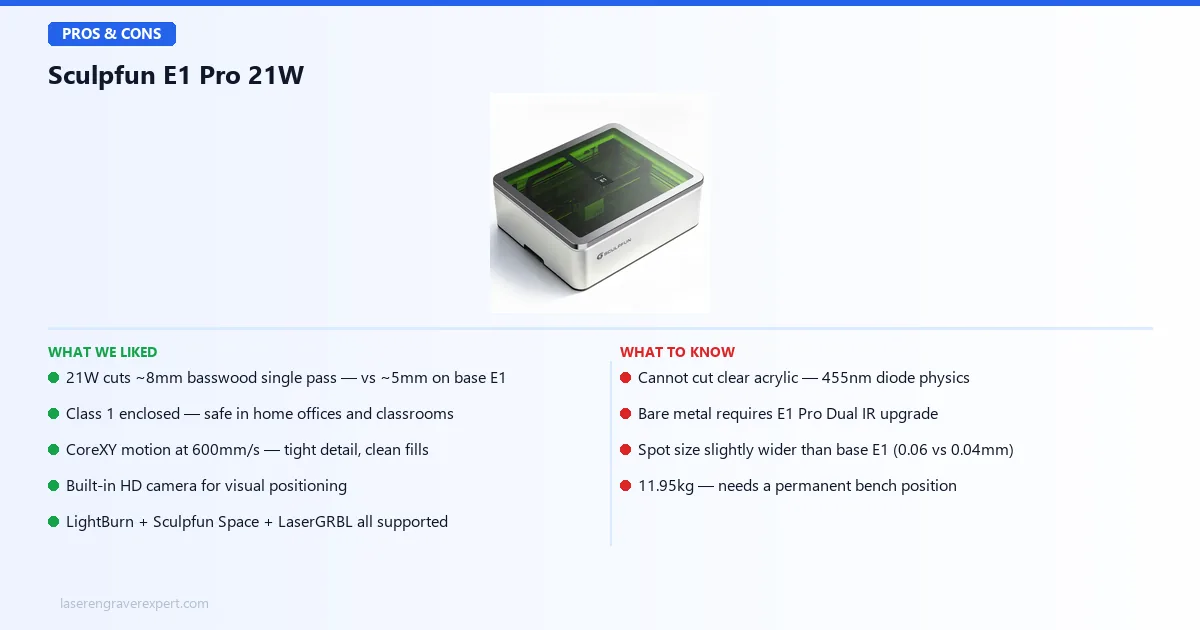
The Class 1 enclosure and CoreXY motion system are what make the E1 Pro more than just a wattage bump. Here is what the full package actually delivers.
Class 1 Safety: The Spec That Determines Where This Machine Can Live
Class 1 means the laser is contained during operation. No safety goggles. No dedicated room. No restricted-access signage.
That determines where the machine can live: a home studio, a shared office, a classroom, an apartment. Open-frame Class 4 diode machines cannot go in any of those spaces safely. The E1 Pro can.
The IEC60825 certification is a verified classification, not a marketing sticker. The lid-open auto-pause mechanically prevents the laser from firing with the enclosure open. The emergency stop and protective viewing cover round out a safety stack that makes this machine genuinely usable in family and shared-space environments.
CoreXY Motion: Why It Matters at 600mm/s
Most open-frame diode lasers at this price use a Cartesian gantry: the bed moves on Y, the head moves on X. Functional, but prone to ringing and ghosting on diagonal fills and fine curves at high speed.
CoreXY drives the laser head in both axes simultaneously using fixed motors. Moving mass stays lower. The system stays stiffer. At 600mm/s, this shows up in cleaner diagonal passes, tighter text, and better consistency across large fill areas.
At this price inside a fully enclosed machine, CoreXY is still unusual. It is one of the clearest reasons the E1 Pro competes above its bracket.
Build and Footprint
At 590 × 500 × 205mm and 11.95kg, the E1 Pro is roughly the footprint of a large microwave. Not portable; plan for a dedicated bench spot.
The full enclosure adds bulk over open-frame competitors. That bulk is the point: it contains the beam, the fumes, and the noise. The built-in exhaust airflow handles immediate smoke extraction. For long cutting sessions, supplement with a window vent or external filter.
The HD positioning camera feeds into Sculpfun Space. Place your material, get a live canvas overlay, drag your design into position, run the job. It removes the manual-measurement step that slows down every job on camera-less machines.
Sculpfun E1 Pro Software: Sculpfun Space, LightBurn, LaserGRBL
| Software | Cost | Best For | Platform |
|---|---|---|---|
| Sculpfun Space | Free | Beginners, camera positioning, mobile workflow | Windows, macOS, Android, iOS |
| LightBurn | ~$60 one-time | Advanced toolpathing, multi-layer, production work | Windows, macOS, Linux |
| LaserGRBL | Free | Open-source users, manual GRBL control | Windows only |
Best for beginners → Sculpfun Space. Camera integration is native. Works on Android and iOS. Simplified UI means less time configuring, more time producing.
Best for advanced users → LightBurn. Full layer sequencing, precise power ramping, cut order control, none of which Sculpfun Space exposes. Existing LightBurn licenses from other machines transfer at no extra cost.
Best free option → LaserGRBL. Sparse interface, but functional. Solid fallback for Windows users who want direct GRBL control without paying for LightBurn.
Sculpfun E1 Pro Performance
Engraving Performance
The 0.06 × 0.08mm spot delivers clean detail on wood, leather, and opaque acrylic. Fine text, intricate linework, and grayscale photo engraving all produce consistent results with CoreXY holding speed and position tightly at 600mm/s.
One counterintuitive note: the base E1’s spot is actually tighter at 0.04 × 0.06mm. For ultra-fine detail on small items, the E1 has a theoretical resolution edge. In practice at 600mm/s on CoreXY, neither spot size is the limiting factor for most projects, but it is worth knowing.
Grayscale photo engraving on basswood produces clean tonal separation. Banding is minimal at speed, a common problem on cheaper Cartesian machines that CoreXY largely eliminates.
Cutting Performance
At 21W, the E1 Pro pushes roughly 8mm basswood in a single pass, versus approximately 5mm on the base E1. That gap is the primary reason to choose the Pro.
For 6mm plywood, the E1 Pro typically achieves a clean single pass. Glue-layer density in some plywood brands may require a second pass regardless of power (a material variable, not a machine limitation). Dark acrylic cuts cleanly with the built-in exhaust airflow handling smoke from the cut zone.
Leather cuts fast and clean at low speeds. Thin leather in a single pass; heavier stock in two. The enclosed airflow keeps the cut environment cleaner than open-frame machines on leather, which smokes heavily.
Supported Materials
| Material | Expected Capability | Notes |
|---|---|---|
| Basswood (3mm) | Single pass cut | Clean edges, minimal charring |
| Basswood (8mm) | Single pass cut | Near the ceiling, lower speed required |
| Plywood (6mm) | Single pass cut | Glue layers may need a second pass |
| Dark/Opaque Acrylic | Single pass cut | Air assist essential for clean edges |
| Transparent Acrylic | Not compatible | 455nm passes through, CO2 required |
| Leather | Engrave and cut | Excellent detail; ventilation essential on long sessions |
| Bamboo | Engrave and cut | Fast, clean; one of the best materials for this machine |
| Coated/Anodized Metal | Engrave only | Anodized aluminum, laser paint, powder coat all respond well |
| Bare Metal | Not compatible | Requires IR laser, see E1 Pro Dual |
| Stone and Ceramic | Engrave only | Slow passes, surface marking |
| Glass | Surface etch only | Diode cannot achieve deep engraving |
Can the Sculpfun E1 Pro Cut Clear Acrylic?
No, and this catches buyers off guard consistently.
A 455nm diode passes straight through transparent material without absorption. Clear acrylic will not engrave or cut regardless of power settings. Only dark or opaque acrylic works.
This is a diode wavelength constraint that applies to every 455nm machine on the market, not an E1 Pro-specific limitation. If clear acrylic is part of your regular work, you need a CO2 laser. See our best CO2 laser engravers guide .
Sculpfun E1 Pro vs E1: Is the Upgrade Worth It?
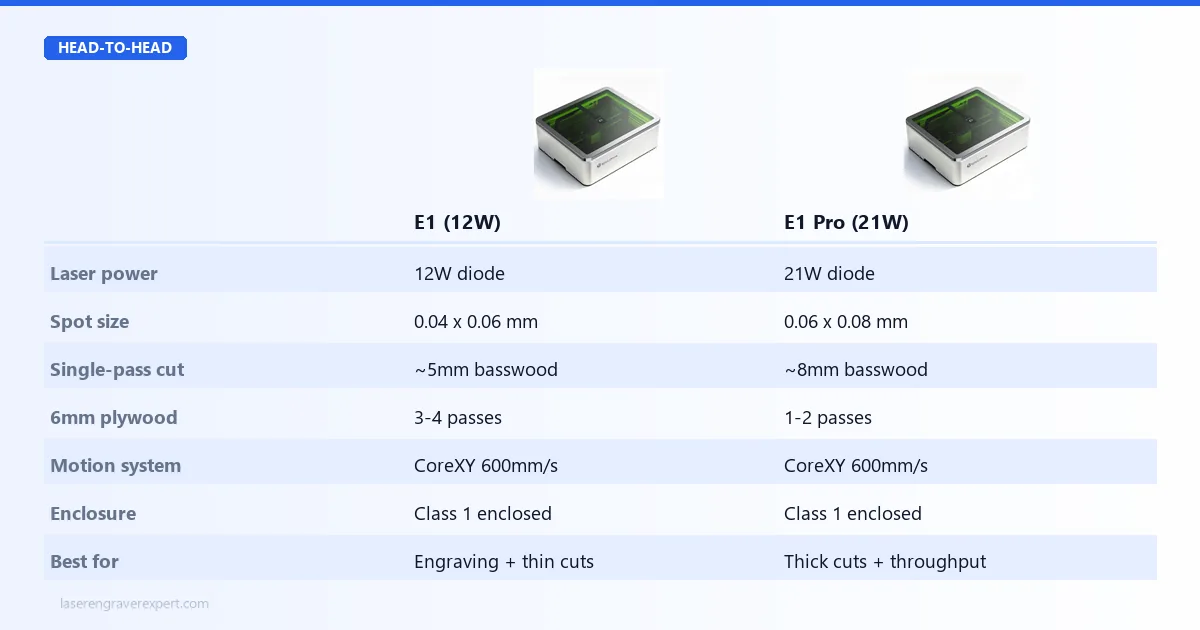
Same chassis, same enclosure, same camera. The only variable is laser output, and whether 9 extra watts justifies the price difference depends on your material list.
The Real Difference: Pass Count and Job Time
The spec table makes these machines look nearly identical. Here is what actually separates them in practice.
6mm plywood: the E1 needs 3-4 passes. The E1 Pro does it in 1-2. Cut a batch of 20 coaster blanks and that is the difference between a 40-minute job and a 15-minute job. At any production pace, that gap compounds across every thick-material job you run.
Single-pass basswood ceiling: E1 tops out at ~5mm. E1 Pro pushes to ~8mm. That opens up product categories: thicker box sides, deeper relief cuts, denser hardwoods that 12W chars rather than cuts cleanly.
The counterintuitive spec: the base E1 has a tighter spot at 0.04 × 0.06mm vs the Pro’s 0.06 × 0.08mm. For ultra-fine engraving (small text, intricate detail on keychains or jewelry) the base E1 has a measurable resolution edge. The Pro trades spot precision for raw cutting power.
Bottom line: if your work is primarily engraving and occasional thin cuts, the base E1 is the smarter buy; our Sculpfun E1 review covers that model in full. The E1 Pro exists for one reason: you need to cut thicker material faster.
| Feature | E1 (12W) | E1 Pro (21W) |
|---|---|---|
| Laser Power | 12W | 21W |
| Spot Size | 0.04 × 0.06mm | 0.06 × 0.08mm |
| Single-Pass Basswood | ~5mm | ~8mm |
| 6mm Plywood | 3-4 passes | 1-2 passes |
| Motion System | CoreXY 600mm/s | CoreXY 600mm/s |
| Enclosure | Class 1 enclosed | Class 1 enclosed |
| Camera | Built-in HD | Built-in HD |
| Input Voltage | 24V 4A | 24V 6A |
Buy the E1 Pro if:
- ✓ You regularly cut 6mm+ plywood, MDF, or dense hardwood
- ✓ Job time matters: 21W advantage compounds across every thick-material run
- ✓ You are scaling from occasional hobby use to small-batch production
Stick with the base E1 if:
- ✓ Mostly engraving: wood, leather, bamboo, coated metal
- ✓ Cutting stays under ~5mm most of the time
- ✓ Fine detail work is a priority: the tighter 0.04mm spot wins here
- ✓ Budget is the deciding factor
Sculpfun E1 Pro Dual: What the IR Laser Actually Enables
The E1 Pro Dual adds a 3W infrared laser at 1064nm alongside the same 21W diode. Here is exactly what that changes.
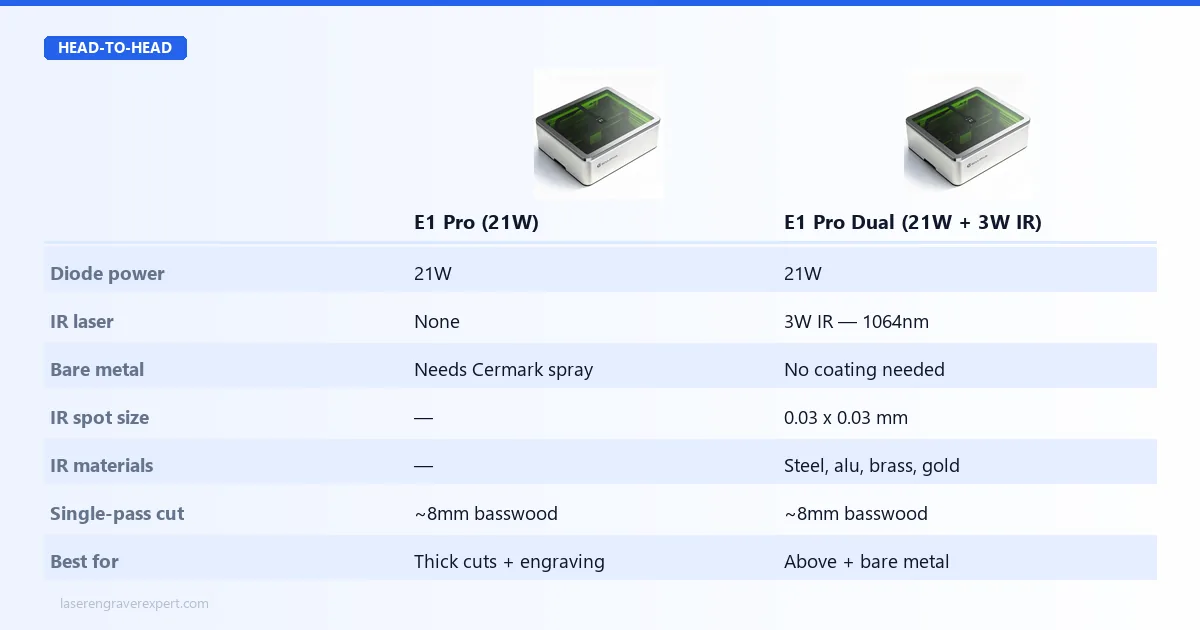 That single addition changes the machine’s material range fundamentally, and it is the version most small business operators should be looking at.
Why the Standard E1 Pro Cannot Mark Bare Metal
A 455nm diode cannot mark bare metal. Period. Steel, raw aluminum, brass, copper, silver: the blue wavelength reflects off them without absorption. You can spray Cermark or similar marking compounds and engrave over the coating, but that adds $30–$50 per bottle, prep time on every piece, and cleanup after every job.
The 3W IR laser at 1064nm is absorbed directly by metal surfaces. No compound. No prep. Place the item, run the job, done. That is not a minor convenience; at any production volume, eliminating Cermark from the workflow saves real money and real time.
| Feature | E1 Pro | E1 Pro Dual |
|---|---|---|
| Diode Power | 21W | 21W |
| Diode Spot Size | 0.06 × 0.08mm | 0.06 × 0.08mm |
| IR Laser | None | 3W (1064nm) |
| IR Spot Size | N/A | 0.03 × 0.03mm |
| Bare Metal Engraving | No, coating required | Yes, no compound needed |
| Single-Pass Cut (basswood) | ~8mm | ~8mm |
| Machine Weight | 11.95kg | 12.05kg |
| IR Engravable Materials | N/A | Stainless steel, aluminum, brass, copper, silver, gold, titanium, platinum |
What the IR Module Marks: Without Any Coating
- ✓ Stainless steel: tumblers, dog tags, cutlery, kitchen items, tools
- ✓ Raw aluminum: machined parts, nameplates, business card holders
- ✓ Brass and copper: jewelry findings, decorative hardware, plaques
- ✓ Silver and gold: jewelry engraving, hallmarking
- ✓ Titanium: surgical instruments, premium accessories, EDC gear
- ✓ Certain plastics: types the diode cannot mark cleanly
The IR spot at 0.03 × 0.03mm is notably tighter than the diode’s 0.06 × 0.08mm. Fine detail on metal (serial numbers, small logos, intricate patterns) benefits directly from that precision. The IR module does not cut; it marks. For cutting, the 21W diode handles the same materials as the standard E1 Pro.
Who Should Buy the E1 Pro Dual
Buy it if:
- ✓ Custom metal gifts are part of your product range: tumblers, dog tags, jewelry
- ✓ You want to eliminate Cermark from your workflow entirely
- ✓ Your clients ask for bare metal engraving and you currently turn it down
- ✓ You want one machine that handles wood, leather, and metal without a second system
Skip it if:
- ✗ Your material list never includes bare metal: you are paying for a module you will not use
- ✗ Occasional metal jobs justify a $30 Cermark spray rather than the price premium
- ✗ You are a woodworker, leather crafter, or sign maker: the standard E1 Pro covers everything you need
E1 Pro Dual vs Standard E1 Pro: The Decision
The E1 Pro Dual costs more than the standard E1 Pro. The question is whether bare metal marking is a core part of your revenue or an occasional request.
If you run a custom gifts business and 30% or more of your orders involve metal items (tumblers, jewelry, dog tags), the Dual pays for itself by eliminating Cermark costs and prep time. If metal is rare, the standard E1 Pro with a can of Cermark on standby is the smarter spend.
Who Should Buy the Sculpfun E1 Pro?
✓ Small business operators running wood signs, leather goods, and mixed-material products daily. Class 1 enclosure means no dedicated laser room; run it in a shared studio or home office.
✓ Serious hobbyists scaling out of open-frame machines. Moving to Class 1 enclosed removes goggles, ventilation setup, and supervision requirements. The workflow simplification alone is worth the price jump for daily users.
✓ Crafters who regularly cut 6mm+ stock. 21W in a single pass on 6mm plywood is where the E1 Pro separates itself from the field at this price.
✓ LightBurn users switching machines. Existing license transfers. Existing files transfer. Zero re-learning cost on the software side.
Who Should Skip the Sculpfun E1 Pro?
✗ Clear acrylic users: 455nm cannot process transparent material. A CO2 machine is required. See our best CO2 laser engravers .
✗ Bare metal engravers: the standard E1 Pro requires coating compounds on every metal job. The E1 Pro Dual with 3W IR is the right answer.
✗ Pure hobbyists doing occasional light work: if cutting stays under 5mm most of the time, the base E1 handles it at a lower price.
✗ Production businesses needing high-duty-cycle hardware: the E1 Pro is built for small-batch and hobbyist daily use, not 8-hour production runs.
Sculpfun E1 Pro vs xTool S1: How Do They Compare?
The xTool S1 is the most direct competitor: enclosed, CoreXY, Class 1, built-in camera. Key differences:
The S1 offers 20W and 40W options versus the E1 Pro’s single 21W configuration. The S1’s work area is slightly larger at 498 × 330mm versus 400 × 320mm. xTool Creative Space is a more mature software ecosystem than Sculpfun Space, with deeper AI-assisted features built in.
The E1 Pro is typically priced lower. If budget is the deciding factor and your work stays within the 400 × 320mm footprint, the E1 Pro is a solid save. If you want a larger bed and a more established ecosystem, the xTool S1 review covers why that extra spend is justified for heavier use cases.
Sculpfun E1 Pro Review: Final Verdict
The Sculpfun E1 Pro earns an 8.6 out of 10.
Class 1 enclosure, CoreXY motion at 600mm/s, 21W cutting power, and a built-in positioning camera at under $550: that combination does not have many direct competitors. It works in a home office, handles 6mm plywood in a single pass, and runs both Sculpfun Space and LightBurn without friction.
The ceiling is clear: no transparent acrylic, no bare metal without the Dual upgrade. Know your material list and choose accordingly.
- Cut 6mm+ stock regularly → E1 Pro is the call
- Need bare metal marking → step up to E1 Pro Dual
- Mostly engraving under 5mm → save money with the base E1
- Clear acrylic is core to your work → this is not your machine
Ready to buy?
Check Current Price on Amazon →